
Statistical activities on the Estonian territory prior to the creation of the State Statistical Central Bureau
Author: Hiljar Tammela
A requirement for statistics is the availability of data. More continuous accumulation of large amounts of data and first efforts to analyse these could be observed on the Estonian territory as well as internationally since the 17th century. It was made possible by changes on both the intellectual and material level of the early modern period: a more secular way of thinking promoted a more rational interpretation of the world and stronger power structures enabled to collect and process data in a better way.
In the 17th century when the territory of Estonia was under the Swedish rule, parish registers were introduced (pastors registered births, marriages and deaths in their congregations), and land subject to tax was documented in regular censuses (land surveys). In the next century, under Russian rule, the registration of people subject to tax was taken up. These documents are extremely valuable: in addition to the benefits at the time and later for historians, the said materials are where most of the knowledge of contemporary Estonians about their early family history and descendance originates.
The beginning of statistics in the modern sense, which means regular collection, processing and publishing of data of different domains, on the Estonian territory was the 19th century. The Russian Empire’s statistical system, which was established in the first decades of the century, turned out to be ineffective and remained weak; therefore, it was set on a stronger foundation with reforms in the 1860s. Statistical committees were established for the provinces. Their main task was to collect local data and transmit these for the surveys conducted by the Statistical Central Committee of the czarist country as well as for the annual aggregate reports submitted by the governor to the central authorities.
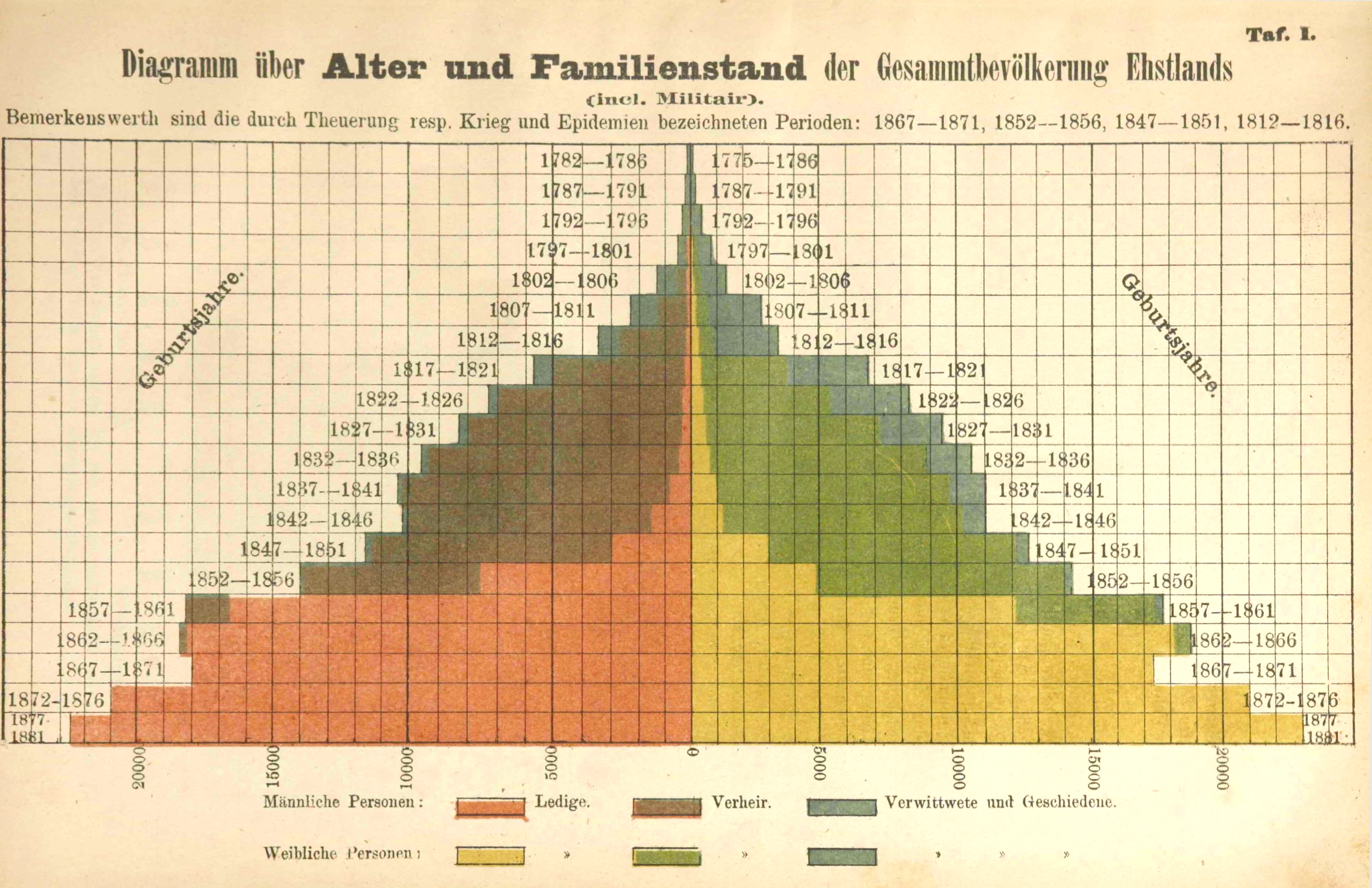
Population pyramid of the Estonian province according to the data of the 1881 census. In addition to traditional indicators such as age (4-year age groups) and sex (males on the left, females on the right), the diagram includes marital status. Red stands for single males and yellow for single females, brown for married males and green for married females, blueish grey for widow(er)s. Reproduction
As the committee was made up of top local officials, the actual statistical work was left to its paid secretary, whose personal initiative and abilities probably built the reputation of the committee. The heyday of the provincial statistics of the Baltic Sea parishes, in which Baltic Germans of the Russian Empire formed the upper class, were a couple of decades in the second half of the 19th century, between the establishment of committees and the general Russification that started at the end of the century.
The person responsible for most of the statistical accomplishments of the Estonian province was Paul Jordan (1825–1894, secretary of the statistical committee 1865–1893). He organised the 1871 census in the towns of the Estonian province and in 1881 in the whole province (at the same time also in Livland and Courland), the results of which were analysed and published in several volumes. The multi-talented Paul Jordan, who mainly worked as a secondary school history teacher, has left his mark in the Estonian cultural history as an author of several historical papers and as the collection manager of the Provincial Museum. In the Livonian province, a comparable champion of statistics was Friedrich von Jung-Stilling (1836–1888), an organiser of censuses and statistical work in the region.
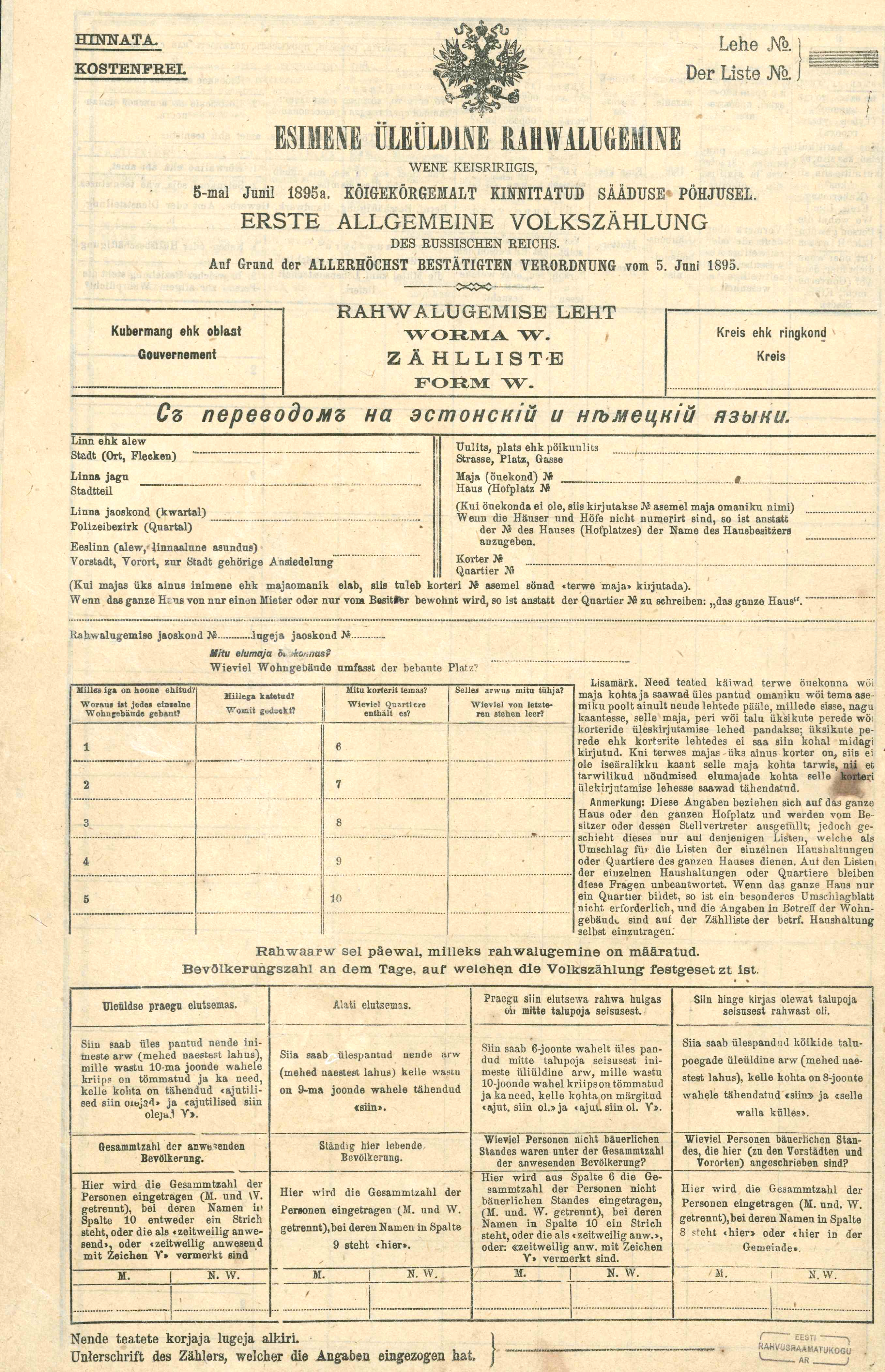 Translation of the official Russian-language census form of the first Russia-wide census (1897) into local languages (Estonian, German). National Library
In addition to official reporting and census statistics, 19th century Baltic-German educators are linked to the so-called school of biostatics, which developed at the medical faculty of the University of Tartu. Those engaged in biostatics defended Doctoral theses on the healthcare conditions of smaller regions (a local town or parish) over a few decades. These theses are a unique body of material.
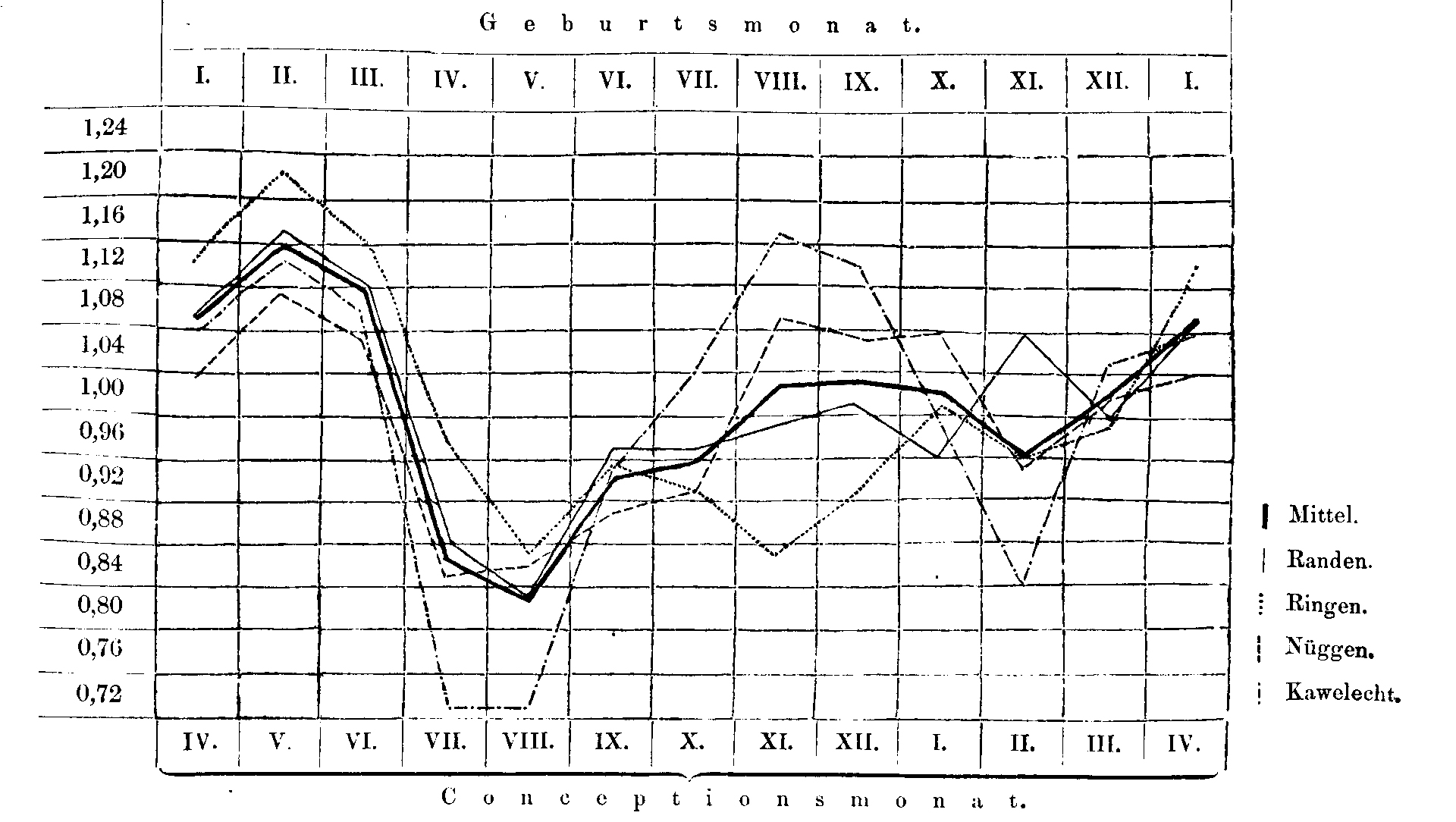 Graph from the Doctoral theses of the most well-known biostatician Bernhard Körber (1837–1915). Difference of the monthly birth rate from the annual average (1.00) in Rannu (Randen), Rõngu (Ringen), Nõo (Nüggen) and Puhja (Kawelecht) parishes of Tartu district, on the basis of the dataset for 1834–1859. Reproduction
In addition to statistical research, the Baltic-German writers published smaller studies about the local conditions in the spirit of Heimatkunde (local history). Probably not much of permanent value was created in this area, as over time and with the disappearance of the Baltic-German readers, this literature has generally been forgotten.
Statistical matters were not only an interest of the non-Estonian-speaking upper classes; this is proved, for example, by the early Estonian-language media. As soon as at the end of the 1860s, or soon after the establishment of the statistical committees of the provinces, the word “statistics” appeared on the pages of Estonian newspapers: readers must have been familiar with the term. In the following decades, smaller statistical aggregate tables (probably based on the materials published in German- and Russian-language papers) were published for Estonian readers. One of the first well-known statistical papers, written by an Estonian for Estonians and in the Estonian language, was a study published by Nikolai Köstner in the 1915 Young Estonia album. In the paper about population growth in Estonia, the author widely used census materials and other statistical literature.
In a broader sense, these developments formed the foundation on which the State Statistical Central Bureau of the Republic of Estonia could be built.