
Peculiarities of Soviet statistics
Author: Olev Liivik
The Soviet Union inherited a well-functioning statistical system and organisation from the Russian Empire. This system operated under various names until the collapse of the Soviet Union. Regardless of its name, the statistical organisation was in charge of producing and managing national accounts and checking whether statistical data correspond to accounting documents and the actual situation. The importance of accounting and checks was even mentioned by Soviet Union leader Joseph Stalin, as he stated that “No constructive work, no state activity, no planning is conceivable without proper accounting. And accounting is inconceivable without statistics. Without statistics, accounting cannot advance one inch” in the 1924 Organisational Report of the Central Committee of the Communist Party, concerning the first national accounts of the Soviet Union.
With the introduction of the system of five-year plans in 1928, the national accounts (consolidated accounts of expenditure, revenue, assets and resources) prepared by the Statistical Central Administration became a tool for managing and planning the national economy. Planning authorities now played a dominant role, with the entire statistical organisation subjected to their power in 1930. The statistical organisation was expected to produce economic accounts, above all, meaning that other statistical domains languished. The reliability of Soviet statistics was a growing concern. In population statistics, a well-known controversy concerns the second census conducted in the Soviet Union in 1937, which was deemed “hostile” and declared invalid since it showed the size of the Soviet population as “only” 162 million, while the estimated population according to official statistics was over 170 million. It was decided to take a new census in 1939, which resulted in a population figure of 170.6 million. In retrospect, it is widely believed that the results were manipulated, but there is no consensus about the number of millions added to embellish the result.
Agricultural statistics in the Soviet era were unreliable and methodologically unsound. In the 1930s, there was a switch to observation in the estimation of agricultural harvests – this meant that the harvested amount was ignored and yield was estimated based on unharvested crops. This peculiar method was abandoned after Stalin’s death, but due to differences in weighing methods it is not possible to compare later statistics either. Namely, the ‘bunker weight’ used in Soviet statistics indicated a higher weight than ‘granary storage weight’ (i.e. net weight), because the former was obtained by weighing crops before cleaning and sorting.
Statistics, like very many other domains in the Soviet Union, were characterised by secrecy. Most of the statistics were classified information, therefore labelled as restricted, top secret or secret, and only available to selected individuals and organisations. There were virtually no statistical releases intended for the general public between the late 1930s and the mid-1950s. After the occupation of Estonia, the Monthly Bulletin of Estonian Statistics was no longer published. There were a few issues of another bulletin (“Eesti NSV rahvamajanduse plaani täitmise näitarve”) published in 1940 and 1941, but this publication was also only available to state authorities.
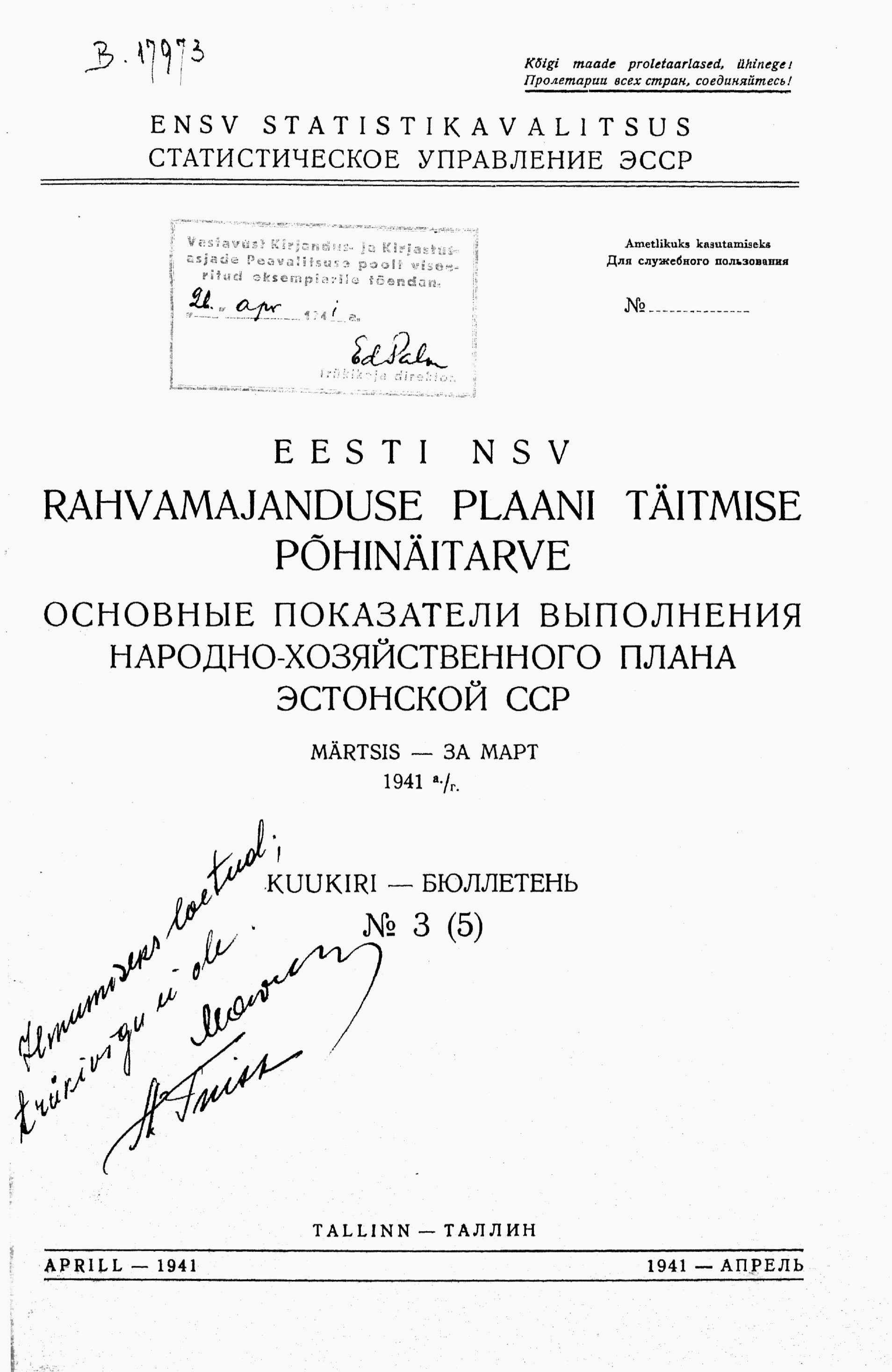 The monthly bulletin of statistics on the fulfilment of plans in the Estonian SSR (“Eesti NSV rahvamajanduse plaani täitmise näitarve”), which was first published in 1940 and replaced the Monthly Bulletin of Estonian Statistics.
The situation improved slightly after the reinstatement of the Statistical Central Administration of the Soviet Union in 1948 when the monthly bulletin of statistics (“Вестник статистики”), which had been closed down in 1929, was published again. At first, the bulletin mainly had articles about the history, methodology and theory of statistics, but in the 1950s it started to also include some statistical materials and surveys. The first post-war statistical publication meant for the general public was “National Economy of the USSR”, issued in 1956. The following year, “National Economy of the Estonian SSR” was published, presenting cherry-picked economic statistics and also a small amount of demographic data. From 1967 onwards, it became a regular yearbook published in Estonian and Russian. In the 1950s, the Statistical Administration started to publish statistical bulletins based on monthly, quarterly and annual data. Local statistical offices issued statistical publications on specific topics, which had a limited number of copies and, again, were not for public use.
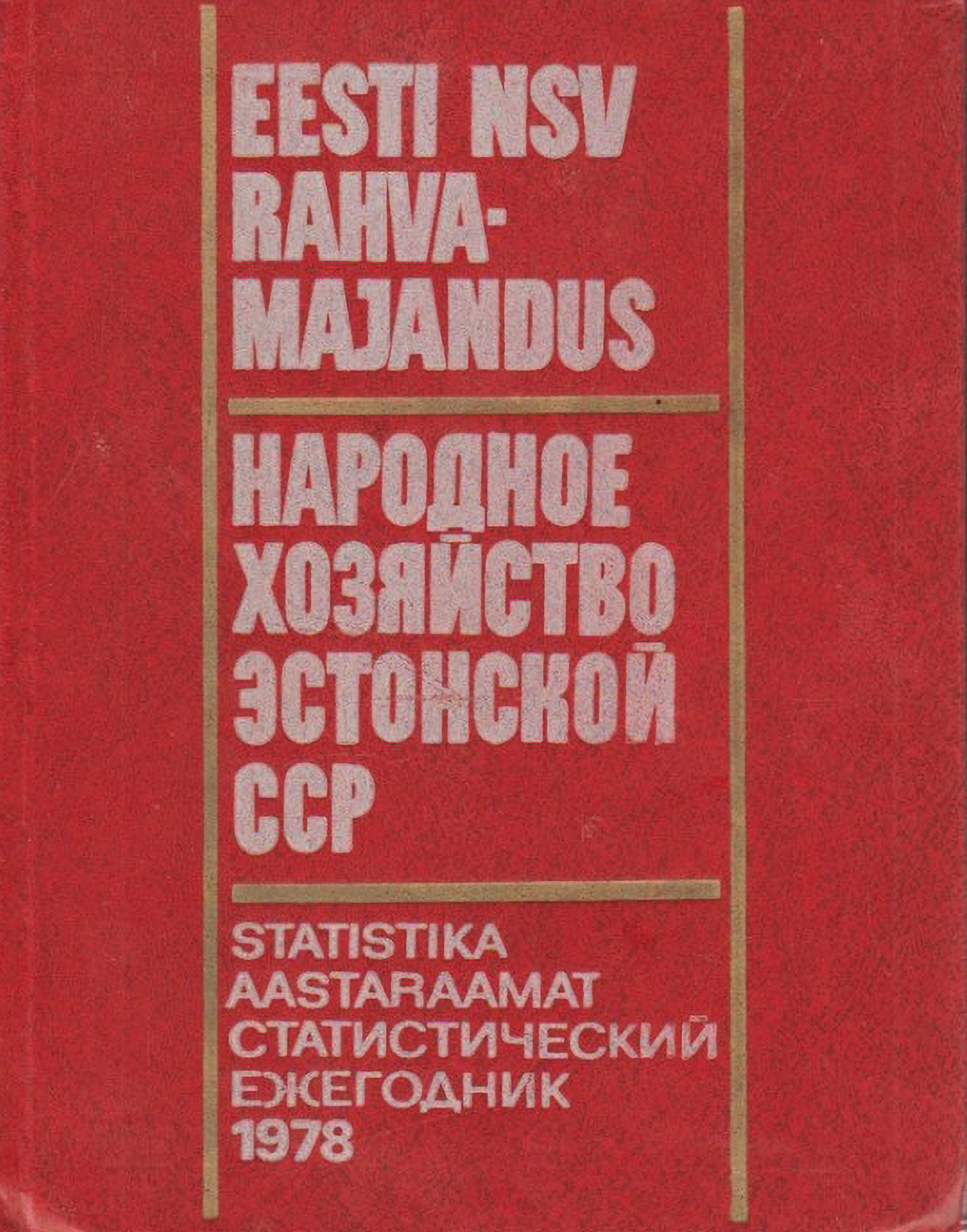
The statistical publication “National Economy of the Estonian SSR” published in 1978
The advances in computing technology led to a fast rise in the number of statistical actions, but before the mid-1980s very few of the results were made public. For example, in 1975, the Statistical Administration of the Estonian SSR completed (and submitted to the relevant authorities) as many as 5,455 statistical actions (data processing, balance sheets, accounts etc.), prepared 106 statistical reports, and published 16 statistical publications and 279 bulletins. These unbelievably high figures remained at a similar level throughout the 1970s.
All of this confirms what Western scholars of Soviet studies have said before: the Soviet government had more statistical information at its disposal than any other government but released fewer data than any other government.
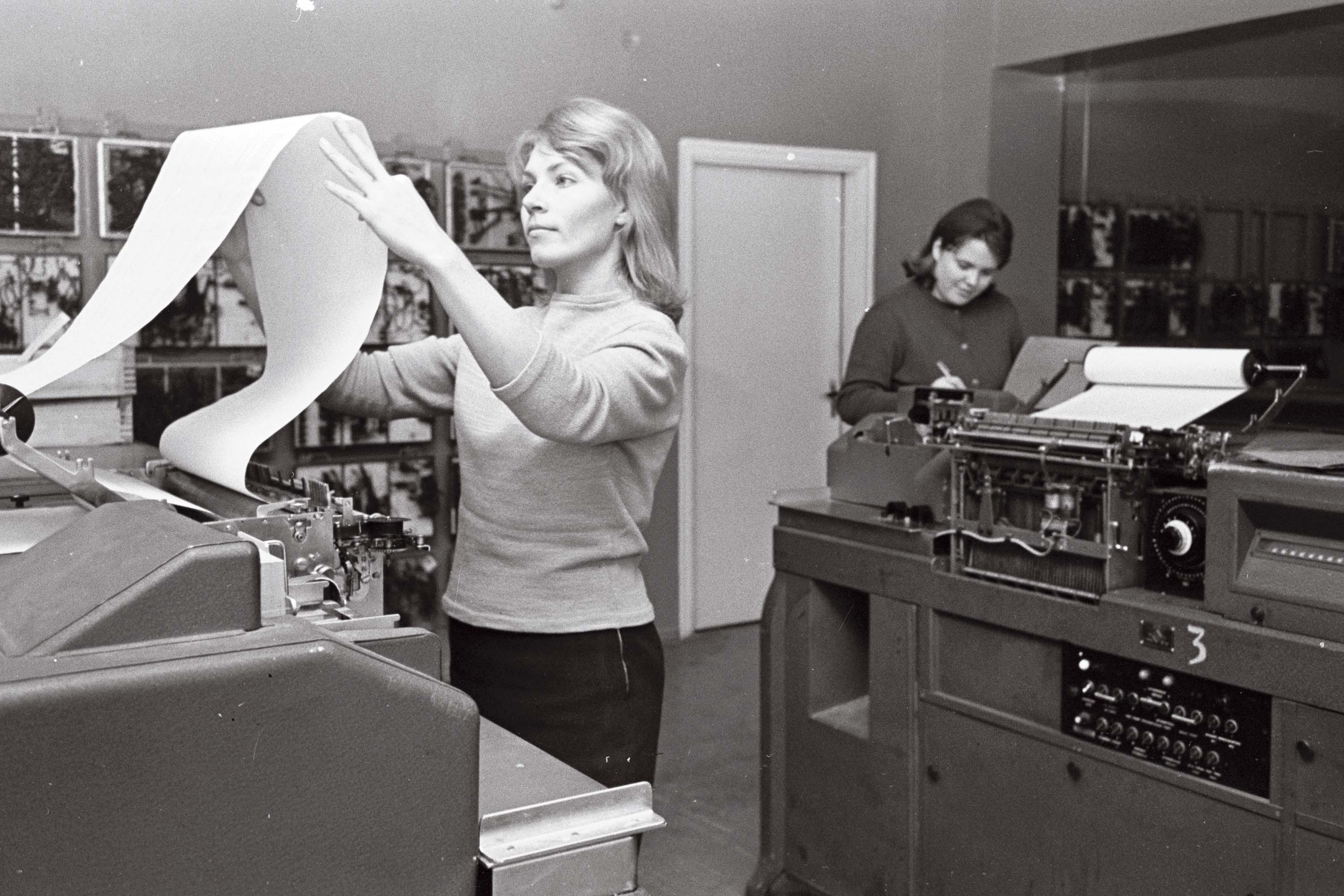 Statisticians working at a machine-computing station of the Statistical Central Administration. Photo: National Archives