Development of the statistical office of independent Estonia
Author: Hiljar Tammela
In the Soviet Union, the statistical authority was not really seen as independently reflecting the current conditions, but rather as a part of state accounting, checking whether there was progress made towards the planned goals. Much of the processed information was also strictly classified. In the second half of the 1980s, there were efforts to fix the enormous country, which was starting to crumble, with the perestroika policy. Public debate was again permitted, decision processes were decentralised, and private enterprise was allowed to an extent – all of these developments shook the Soviet statistical system, which had remained unchanged for decades.
Of course, reforms were implemented, both originating from Moscow and Tallinn. In 1990, Estonia adopted its own statistical act, and the State Statistical Committee of the Estonian SSR was renamed as National Statistical Office to emphasise the right to make decisions locally. The name change was definitely a significant and empowering step, although in everyday work things did not change so quickly.
Lembit Tepp, a long-time top official of the statistical office, described the situation in the spring of 1991: “Lacking money and equipment, we have to navigate between Moscow, which previously placed the orders, and today’s disobedient organisations and enterprises, which do not want to submit their data anymore, telling us that there are no benefits for them”. According to Tepp, this resulted in receiving incomplete data, which did not provide a whole picture of the current state of the Estonian economy.
The resistance of data providers is another trend of the time. The cooperative economy, which emerged during the final years of the Soviet Union, developed by the beginning of the new independence period into so-called cowboy capitalism where the participants did not always follow or even known the rules, if rules even existed. When previously a statistics computing station took care of the whole accounting of a cooperative and transmitted the data to the statistical administration, the financial documentation of the modern business guy could fit in a notebook, as was described by media at the time. Even in the middle of 1990s, there were problems with getting statistical reports from businesses that otherwise had a spotless reputation. The reasons for refusing to submit data included the fear of revealing their trade secret and that there was too much work involved.
Transitioning from a planned economy to a market economy and from a state in the big Soviet empire to an independent Republic of Estonia meant major reorganisation. The institution, which had been subordinated to the central authority in Moscow and had the responsibility to monitor the fulfilling of the plans, had to find its own path now. To analyse changes in the society in an objective and transparent manner was a definite goal, but how exactly to do it, what data and to what volume to collect was the question. In order to become a serious and reliable statistical agency both in Estonia as well as abroad, international classifications and standards were adopted. A lot of help during the reorganisation period, especially initially, was provided by colleagues from Swedish and Finnish statistical offices. Most of the work was still up to Statistics Estonia.
It became clear soon that the introduced reforms tended to be only superficial, and then in 1993, a major structural reform was implemented, which involved replacing the staff. The first director-general Rein Veetõusme (in office 1991–2004), who was in charge of rebuilding the statistical office of the Republic of Estonia, recalled in 1995 that all employees received a notice of dismissal, except for him, as he had to hire the new people. The staff of Statistics Estonia changed by nearly 50%. Those who were laid off lacked professional abilities or language skills.
Since then, Statistics Estonia has been headed by Priit Potisepp (2004–2012), Andres Oopkaup (2012–2017), Mart Mägi (2017–2021) and by Urmet Lee from 2021.
The greatest upheavals, which are also related to social and technological changes, in the development of the statistical office of independent Estonia happened in its first decade. Besides freedom of creativity, the second keyword of the 1990s was the explosion of data communication (mainly the internet). For Statistics Estonia, a data processing institution, it meant both a revolution in data collection as well as dissemination. Using statistics through the online database, which was launched in 2001, turned out to be so convenient that it quickly reduced the readership of printed publications. The Monthly Bulletin of Estonian Statistics (1992–2008) first became a quarterly bulletin (2009–2018) and was then discontinued. The same happened to “Statistical Yearbook of Estonia” (1991–2016). Studies on a particular domain or single papers are now also usually published as e-publications.
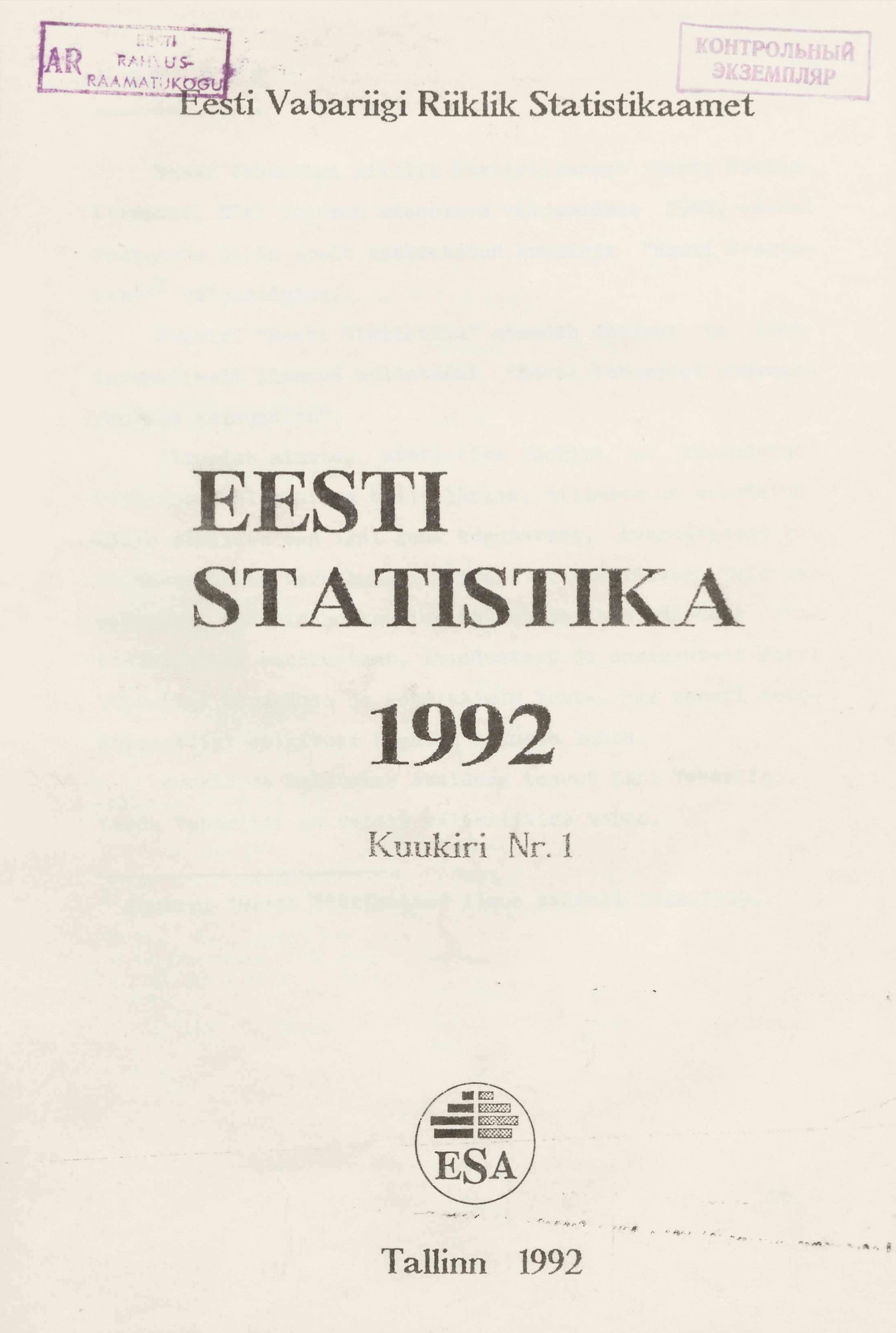
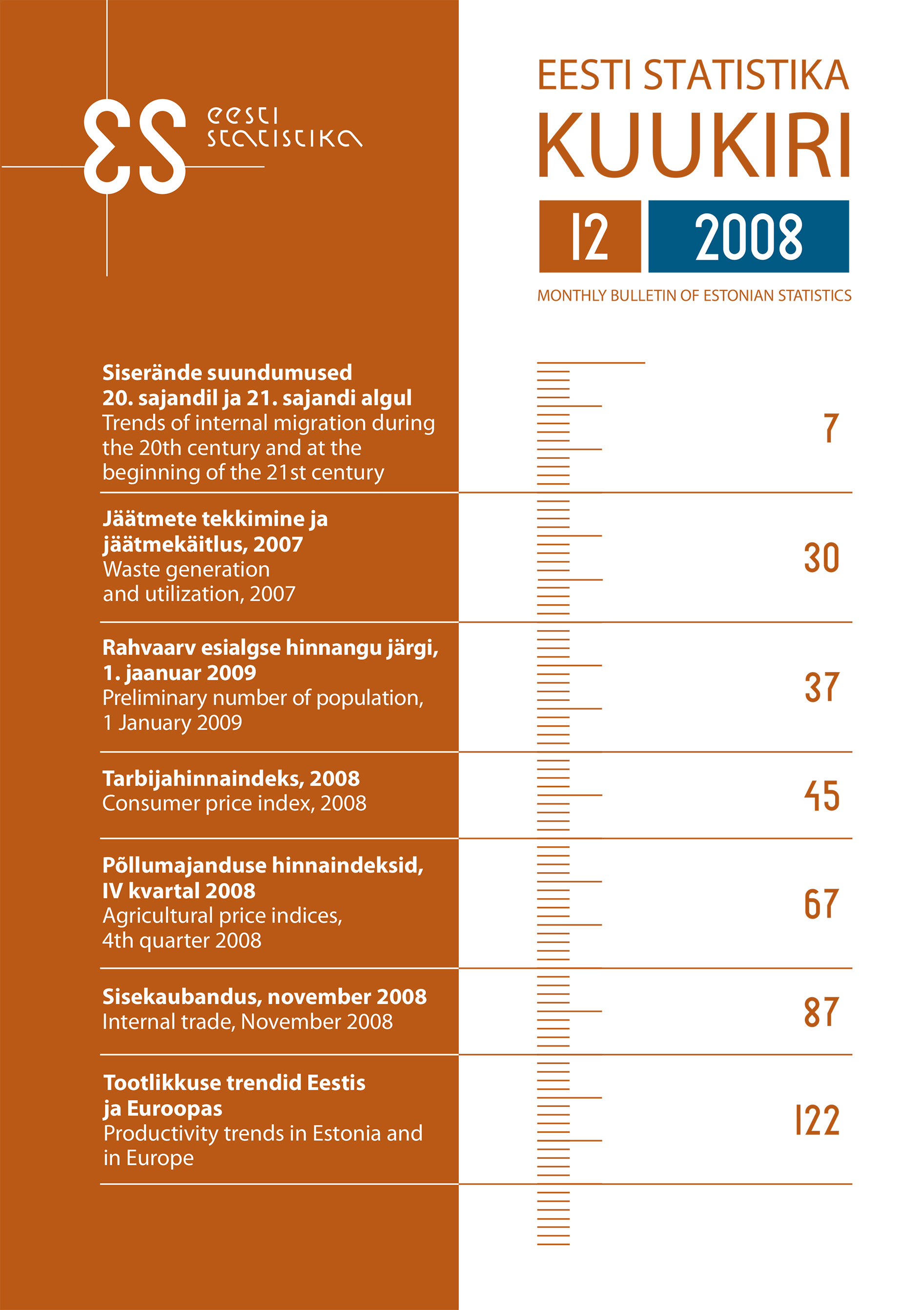
First and last issue of the Monthly Bulletin of Estonian Statistics, published during the second independence period of the Republic of Estonia. Reproduction
The focus in the last decade has been on introducing the activities of state authorities to the public. Statistics Estonia popularises the world of numbers through its widely-used interactive web applications (Tree of Truth, Earnings application, etc.).
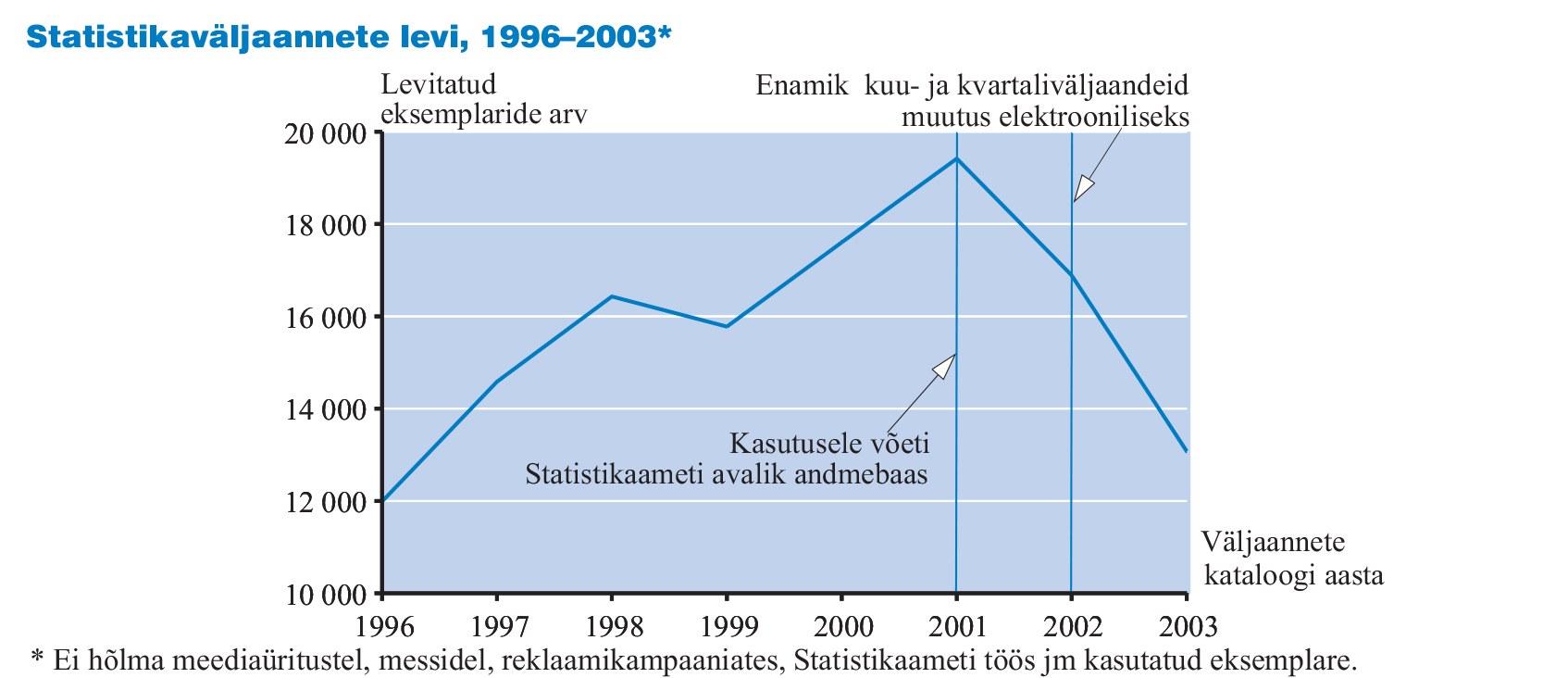 Impact of the web-based statistical database on the distribution of printed publications. Reproduction
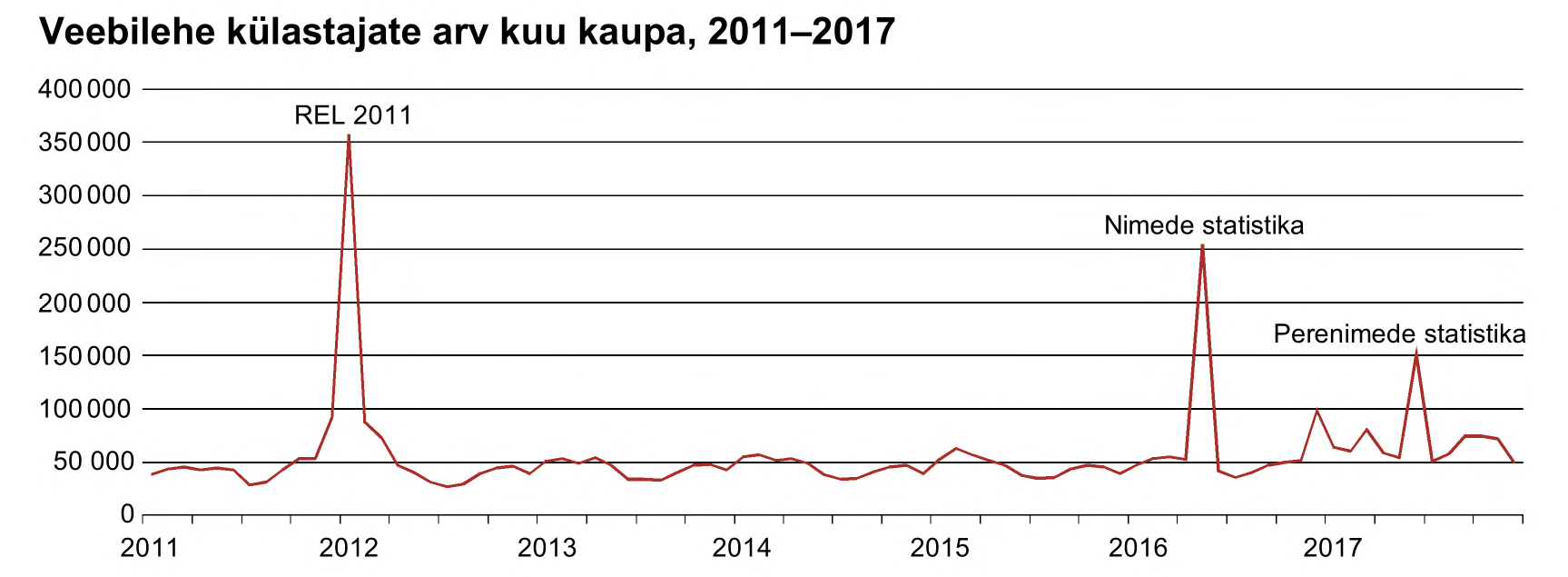 Number of visits to the webpage of Statistics Estonia. Reproduction