
1959 Census
Author: Olev Liivik
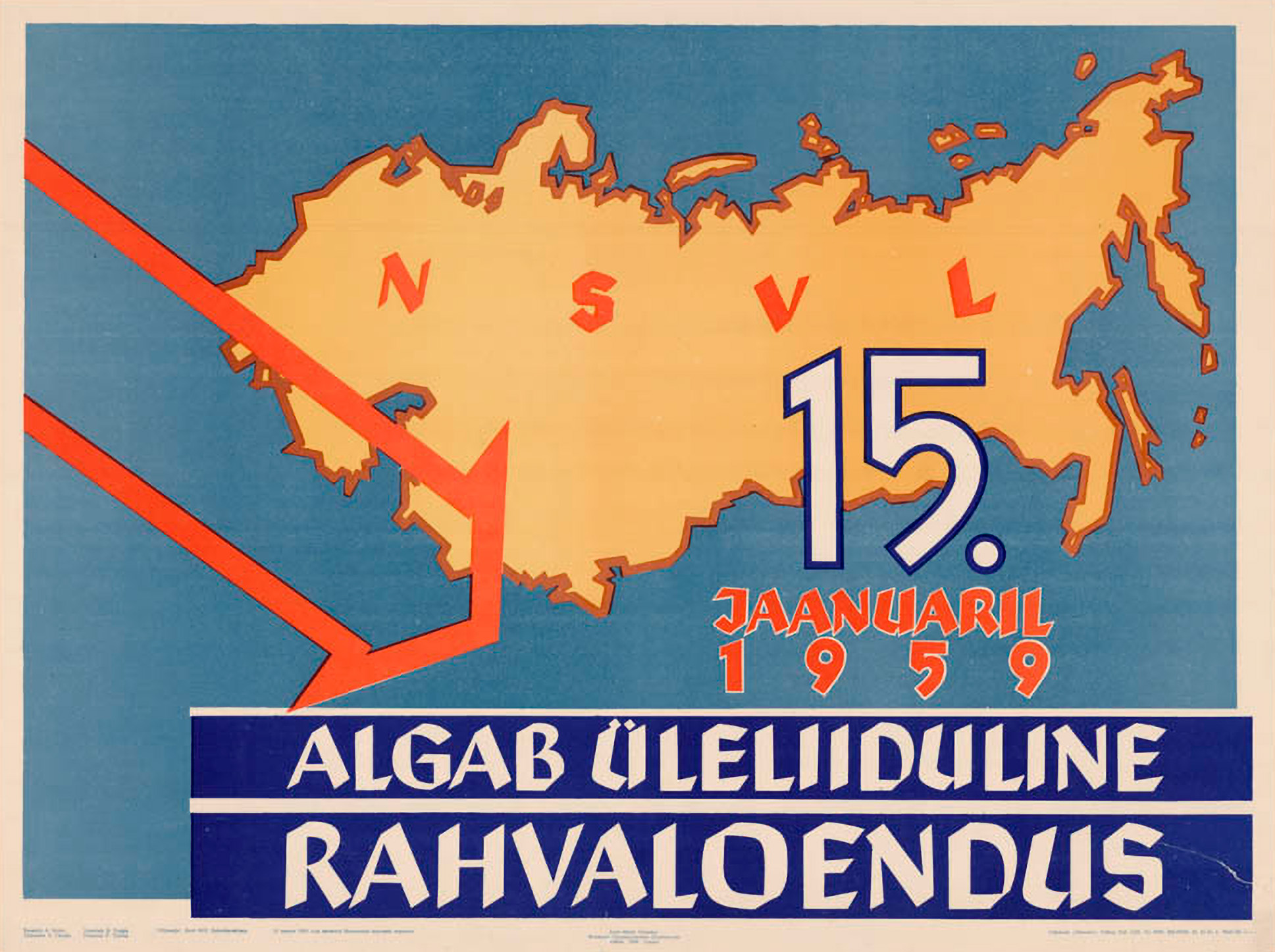
Population censuses in the Soviet Union were centralised, with a uniform process and programme (questionnaire) used across the country. The methodological materials and manuals were developed in Moscow and then distributed around the Union. The processing and analysis of the data and the release of results were also centralised. Thus, Estonia and the other Union Republics were given just the task of conducting the census and sending the data to Moscow.
The first post-World War II population census in the Soviet Union was carried out in 1959, twenty years after the previous census. The census moment was 15 January 1959. The census was taken from 15 to 22 January 1959, with the exception of remote areas where people were enumerated earlier.
Poster advertising the upcoming population census
The formal preparations for the census began in early 1957. The choice of 1959 as the census year was based on the recommendation of the United Nations Statistical Commission, which advised that all countries in the world should conduct a population census in the years ending in 0 or in the adjacent years. For this purpose, the Statistical Administration of the Estonian SSR established a census department in 1957, later renamed as the population and housing census department because, in addition to population censuses, it was also tasked with conducting the housing stock census in cities and towns.
The enumeration lists were based on local population registers. Registering one’s address was mandatory in the Soviet Union and subject to strict rules, therefore the lists of residents were fairly accurate. Still, the accuracy of the lists was checked locally a few weeks before the census. On the other hand, the enumeration maps were not very precise, although they were meant to help the thoroughly trained enumerators to navigate their enumeration area. Lembit Tepp, who was involved in several Soviet population censuses, has said that these were not real maps but more like diagrams. Military sites could not be shown on maps and their surrounding areas were distorted.
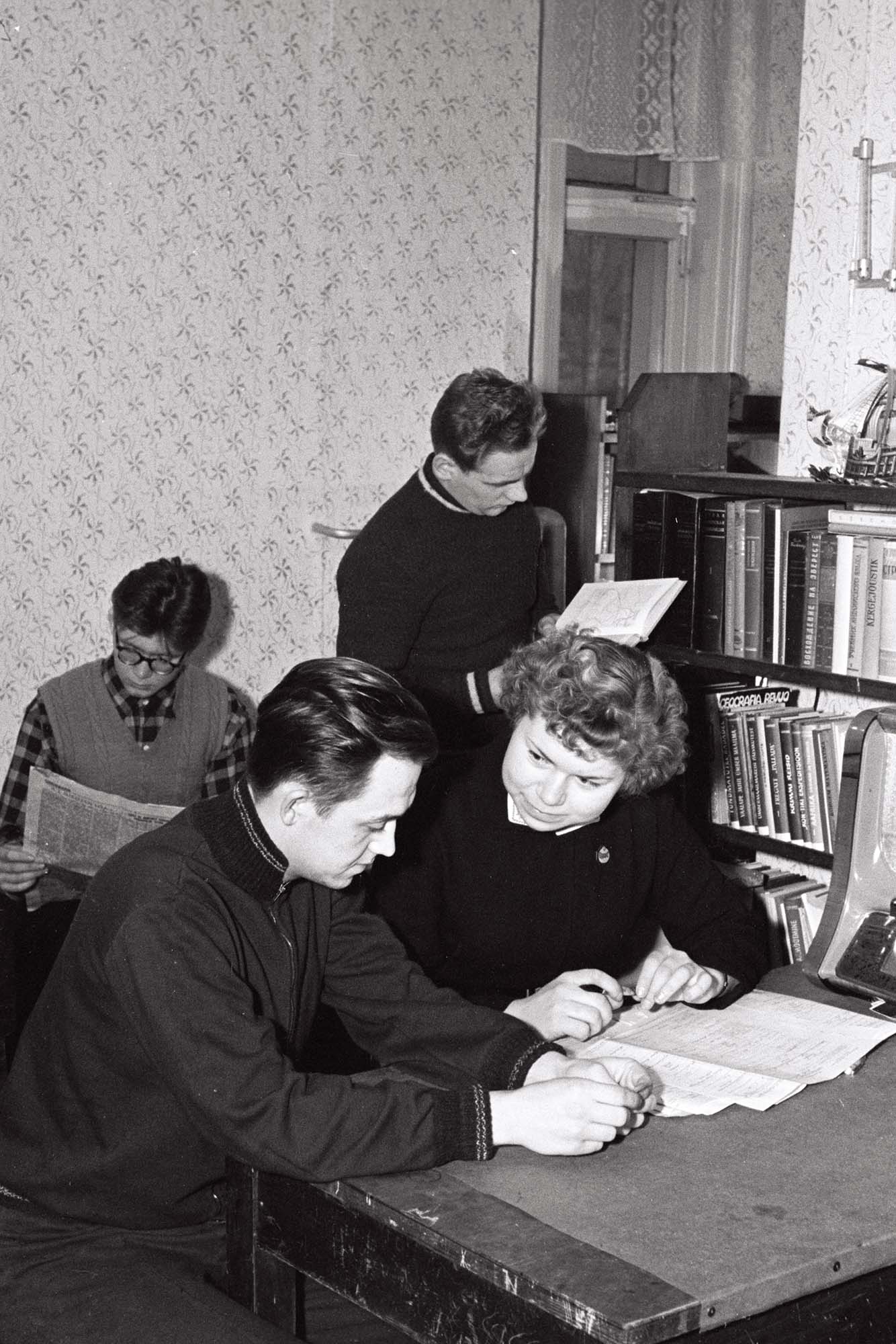 Enumerator interviewing a respondent at a student hostel in Tartu. Photo: National Archives
The census questionnaire was in Russian. The enumerators had to be able to speak both Russian and Estonian, to ensure that respondents who only spoke Estonian would also understand the questions. Regardless, in the 1959 census, information was written on slips printed in Estonian and later transcribed onto forms printed in Russian. The Soviet-era censuses had a shorter programme than the two censuses conducted in the Republic of Estonia in the interwar period. There were 15 questions for respondents: sex, age, place of permanent residence, period of absence from the place of residence, marital status, relation to the head of household, ethnic nationality, citizenship, mother tongue, education, type of educational institution attended, means of subsistence, place of work, occupation at this place of work, social group. The same questionnaire was also used in the three following censuses in 1970, 1979 and 1989.
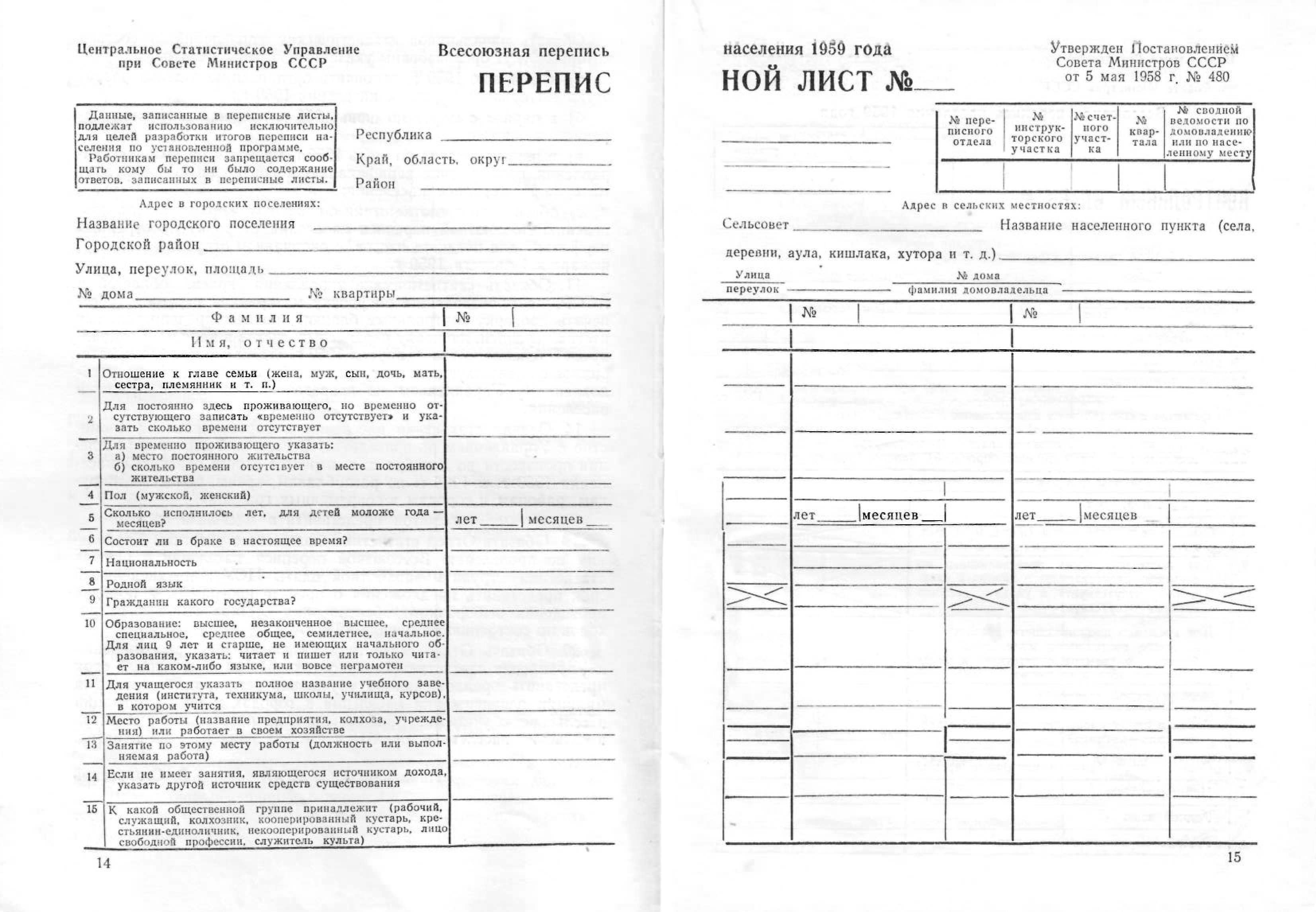 Census form
The results of the first post-war Soviet census were published in 17 volumes: a general volume on the USSR and separate volumes on individual Union Republics. The volume on Estonia, published in 1962, was thin with 108 pages and presented 64 tables with the most general data, such as total population of Estonia, size of urban and rural population, and the population of Tallinn city. Based on the printed data tables received from Moscow, the Statistical Administration was able to release 10 volumes of census results (with over 2,000 pages in total) duplicated using a mimeograph machine, but these copies were intended for relevant authorities only. The source materials of the 1959 census have also been preserved in Estonia – these are the enumeration forms that were to be destroyed as per Moscow’s orders but were saved by Lembit Tepp.
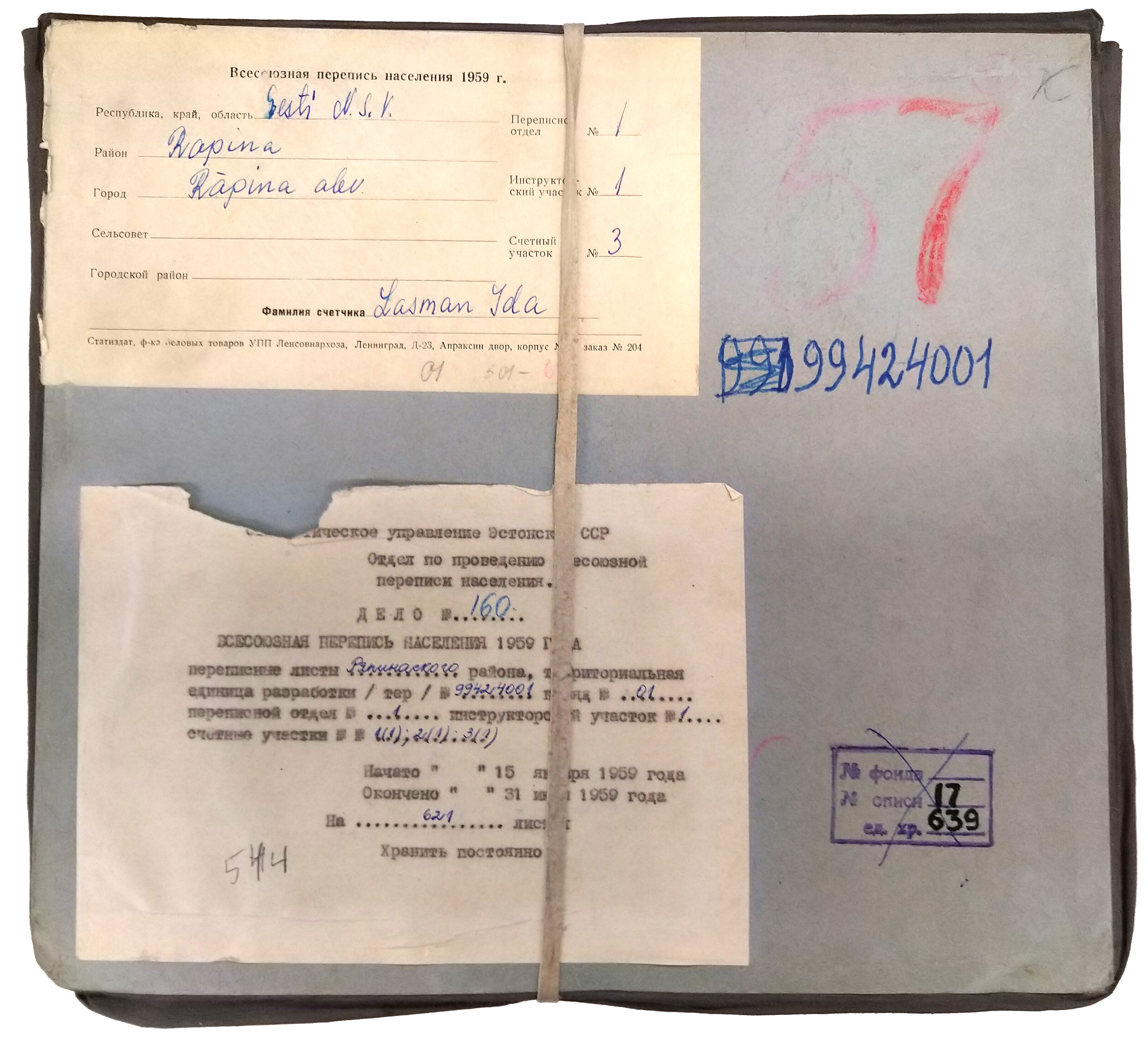 Folder for census forms
The census results showed that the population of Estonia was bigger than ever (almost 1.2 million), having increased by nearly 20% since the 1941 census. But in that time, there had been significant changes in the population, including the ethnic distribution. The share of Estonians had fallen to 74.5% (from over 90% in 1941). The number of Estonians had decreased by over 15,000 compared to 1941, which can be attributed to casualties of war, the emigration to Western countries in 1944, and Soviet repression policies. The fall might have been even steeper if not for the immigration of Estonians from Russian territories in the 1940s. Russians were still the biggest ethnic minority in Estonia, and their share had risen to 20% of the population. There had been dramatic changes in the geographic distribution of the population. The share of residents living in cities was barely a third in 1941 but rose to more than a half by 1959.
The age-sex structure of the population exhibited tell-tale signs of the impact of the two World Wars. The population pyramid of 1959 has a first deep indentation in the 35–45-year-old cohort. This was the generation most harmed in World War II, and the number of men was especially small compared to the number of women. Also, this age group included those born during World War I when birth rates in Estonia went down. The other, smaller indentation in the 10–19-year-old cohort can be explained by the lower number of births in the 1940s as well as by mortality among children being higher than before the war, but it was primarily due to the fact that the generation of 35–45-year-old women were in childbearing age at that time.
Loading chart...